


Members walk into a gym to improve their bodies. While they train, they inhale up to ten times more air than a person sitting in an office — and almost nobody has checked what is in it.
There is an uncomfortable contradiction at the entrance of most fitness centres. The business model is health. The marketing is health. The membership fee is, in the customer’s mind, an investment in health. And yet the indoor environment of a busy training floor is, in strictly microbiological terms, one of the most demanding spaces in a commercial building — closer to a locker room in a hospital basement than to the clean, bright studio in the brochure.
This is not a criticism of gym operators. It is a design problem that the sector inherited and that almost no one has been asked to solve. Ventilation systems in fitness centres are typically sized for thermal comfort, not for biological load. They move air. They do not treat it.
Gyms Sell Health. Very Few of Them Sell Clean Air.
1. Mesophilic aerobic bacteria and the smell everyone recognises
The “gym smell” is not an aesthetic problem. It is a microbiological readout.
Mesophilic aerobic bacteria — the group that thrives at body temperature, between roughly 20 and 45 °C — proliferate wherever there is warmth, moisture and organic matter. A training floor supplies all three continuously: skin cells, sebum, sweat, keratin and textile fibres, at 22–26 °C, with humidity climbing every hour the room is occupied.
As these populations metabolise sweat and skin residue, they release volatile compounds. Isovaleric acid and butyric acid produce the sour, rancid note. Ammonia and trimethylamine come from protein and urea breakdown. Hydrogen sulphide and methyl mercaptan add the sulphurous edge. Indole and skatole appear where organic matter accumulates in mats, upholstery and filters.
When a room smells like a gym, that odour is a direct signal of a high mesophilic aerobic count and insufficient air renovation. Masking it with fragrance dispensers changes the perception without changing the load. In fact, it adds more VOCs to an already saturated atmosphere.
2. The biological load carried by the users themselves
Every member is a source. At rest, an adult moves 6–8 litres of air per minute. During moderate to intense exercise, that rises to 40–100 litres per minute, taken predominantly through the mouth, bypassing the nasal filtration that normally traps particles. The result is a double effect: users emit far more aerosols, and they inhale far more of what others have emitted, deeper into the lower respiratory tract.
Viruses. Rhinovirus and coronaviruses (including SARS-CoV-2), influenza A and B, respiratory syncytial virus and adenovirus (also responsible for conjunctivitis and pharyngoconjunctival fever) circulate readily in the aerosols generated by heavy breathing. Norovirus persists on surfaces and can be aerosolised in sanitary areas. Herpes simplex type 1 — herpes gladiatorum in contact disciplines — spreads through mats and shared equipment. Molluscum contagiosum and, notably, human papillomavirus (HPV) types 1, 2, 27 and 57 are transmitted mainly by contact with damp floors, showers and poolside surfaces, where they cause plantar warts (verrucae). It is worth being precise here: HPV in a gym is a contact and fomite problem, not primarily an airborne one, and any solution should be described accordingly.
Bacteria. Staphylococcus aureus, including methicillin-resistant strains (MRSA), is the classic fitness-centre pathogen, transferred through benches, handles and mats and responsible for folliculitis, boils and soft-tissue infections. Streptococcus pyogenes, Corynebacterium spp. and Micrococcus spp. are routine skin flora that become problematic at high density. Pseudomonas aeruginosa and Klebsiella spp. colonise wet zones, spa areas and drains. Escherichia coli appears in changing rooms and sanitary facilities. And Legionella pneumophila deserves separate mention: showers, whirlpools and any aerosol-generating water system are its preferred route into the lungs.
Parasitic and dermatological agents. Shared mats, floors and towels transfer Sarcoptes scabiei and other contact agents that most operators never consider in an environmental assessment.
3. Humidity: fungi, moulds and yeasts
Sweat evaporation, shower blocks and steam rooms push relative humidity in gyms well above the 40–60 % comfort band, frequently past 70 % in changing areas. Above that threshold, fungal ecology takes over.
Dermatophytes — Trichophyton rubrum, Trichophyton interdigitale and Epidermophyton floccosum — survive on damp floors and cause athlete’s foot (tinea pedis), jock itch (tinea cruris) and onychomycosis. Their spores are released into the air when floors dry and are walked on.
Yeasts such as Candida albicans, Malassezia furfur and Rhodotorula spp. flourish in warm, humid surfaces and on skin under occlusive sportswear.
Environmental moulds — Aspergillus (including A. fumigatus and A. niger), Penicillium, Cladosporium, Alternaria and, in chronically damp construction, Stachybotrys chartarum — colonise ceiling voids, insulation, cooling coils, condensate drain pans and duct interiors. Their spores and mycotoxins are respirable, and they are a well-documented driver of allergic rhinitis, asthma exacerbation and hypersensitivity reactions.
4. The chemical layer nobody measures
On top of the biological load sits a chemical one: aldehydes and terpenes from cleaning and disinfection products, chloramines where there is a pool, plasticisers and benzothiazole off-gassing from rubber flooring and equipment, phthalates from vinyl, and particulate matter from chalk, textile fibres and skin squames. Carbon dioxide, the simplest ventilation indicator, routinely exceeds 2,000–3,000 ppm in spin studios and group classes — levels at which cognitive performance and perceived air quality both deteriorate measurably.
5. The duct itself becomes the reservoir
This is the part most operators overlook. The air handling unit and the duct network sit downstream of everything described above. Warm, humid, organically loaded air passes through filters and over cooling coils, where condensation forms. Biofilm develops. Dust accumulates. The distribution system stops being neutral infrastructure and becomes an incubator that redistributes what it has cultivated — every time the fans start.
A gym can be cleaned impeccably at floor level and still be recontaminated from the ceiling.
Why the usual measures are not enough
- Filtration is passive and partial. A filter only captures what physically reaches it, only while the system is running, and only within its efficiency class. Ultrafine particles and gaseous compounds pass through. Worse, a loaded filter is a nutrient-rich substrate for microbial growth.
- Dilution ventilation is expensive and limited. Increasing outdoor air is the correct baseline strategy, and it is mandatory. But conditioning that air carries a significant energy cost, and dilution reduces average concentration without eliminating anything. It does nothing for the biofilm already inside the system.
- Surface disinfection is a snapshot. Wiping a bench protects the next user for a few minutes. Recontamination begins immediately.
- In-duct UV-C alone treats only the beam. Germicidal lamps act where the radiation reaches. They do not project any effect into the occupied space.
Each of these has a role. None of them acts continuously, on air and surfaces at once, throughout the whole facility.
How ductFIT works
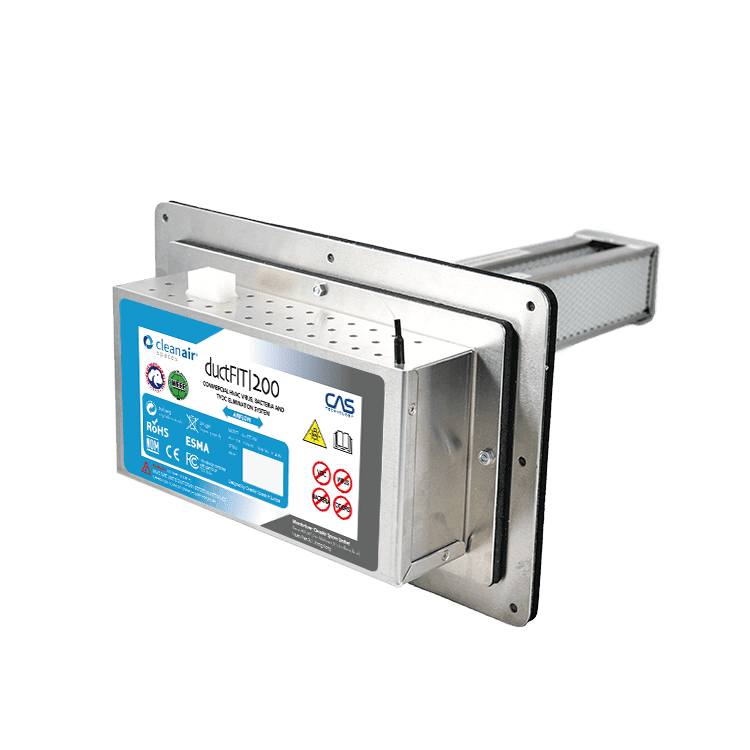
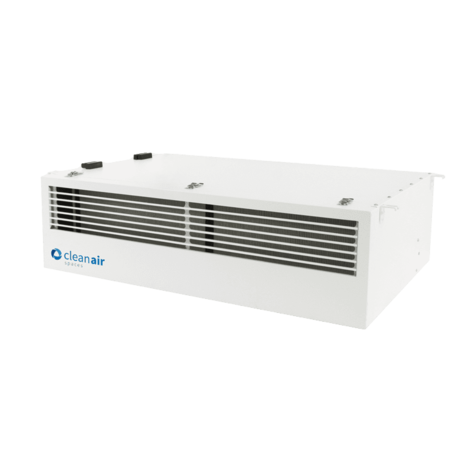
ductFIT is an active photocatalytic system installed inside the air handling unit or the duct network — precisely at the point where a gym’s air is collected, mixed and redistributed.
Its operating principle is heterogeneous photocatalytic oxidation. A UV source activates a catalytic surface, and the energy transferred to the humidity and oxygen naturally present in the air stream generates highly reactive oxidising species — hydroxyl radicals, superoxide anions and related oxidants. These species attack organic matter indiscriminately:
- Microorganisms. Oxidation degrades lipid membranes, cell walls, viral capsids and fungal spore coats, disrupting nucleic acids and structural proteins. The mechanism is physical-chemical destruction, not a metabolic pathway, so bacteria and fungi cannot develop resistance to it in the way they do to biocides and antibiotics.
- Odours and VOCs. Isovaleric acid, ammonia, mercaptans, aldehydes and terpenes are not masked or adsorbed. They are broken down progressively into carbon dioxide and water vapour. The gym stops smelling like a gym because the molecules responsible are no longer there.
Three features matter for a fitness facility in particular:
- It treats the reservoir, not just the room. Installed in the duct, ductFIT acts on the coils, drain pans and duct interiors where biofilm and mould take hold, converting the distribution network from a contamination source into a treatment stage.
- It is continuous and active. It works during peak class hours and it works overnight, when the building is empty and conventional cleaning has finished. Pathogen inactivation does not wait for someone to walk past with a cloth.
- It reaches surfaces the air reaches. Because the active species are carried by the airflow into the occupied zone, treatment extends beyond the air itself to exposed surfaces — mats, benches, handles, changing-room floors — continuously and between cleaning cycles. This complements, and does not replace, the direct disinfection protocols required for contact-transmitted agents such as dermatophytes and HPV.
What the operator actually gains
The odour disappears at source rather than being covered. Airborne microbial counts fall, which shows up in mould-free changing rooms and fewer complaints. Fungal colonisation of the AHU declines, which extends the service life of coils and filters and cuts corrective maintenance. And crucially, environmental quality becomes something the facility can measure and demonstrate — a documented, verifiable claim rather than a promise.
It should be said plainly: ductFIT is not a substitute for code-mandated outdoor air ventilation, nor for cleaning protocols. It is the active treatment layer that these measures lack, and it operates in the one part of the building that touches every room.
The point everyone misses
A gym sells a physiological result. Its members accept discomfort, pay a monthly fee and organise their week around the promise of getting healthier. They scrutinise the protein content of their shakes and the calibration of the equipment.
Meanwhile the substance they consume in by far the greatest volume during that hour — several thousand litres of air, drawn deep into the lungs at up to ten times their resting rate — is the one input nobody in the building is measuring.
Air quality is not an amenity in a fitness centre. It is part of the product. A facility that has genuinely solved it is not just cleaner. It is finally delivering the thing it has been selling all along.
CleanAir Spaces designs and manufactures photocatalytic air and surface purification technology for high-occupancy environments. To assess the environmental load of your facility and evaluate a ductFIT installation, contact our technical team.
Find quality information about the industry and our products. Don’t miss the latest news and events from our writers: CleanAir’s professional and technical team.